

First published: 08/05/19
May is Lyme Disease awareness month and I felt it was important to write a blog post about how to prevent Lyme Disease.
Lyme Disease infection rates are on the increase and this trend is likely to continue, thanks to climate change. Yet, many people do not fully understand what Lyme Disease is or how you contract it.
I fully admit that I was completely naive to Lyme Disease before I fell sick. I didn’t think it was something I could get where I lived and I didn’t understand the risks.
The most important thing to know about Lyme Disease is that it is a disease of exposure. This means there are steps that you can take to protect yourself and minimise the risk of contracting it.
What Is Lyme Disease
Lyme Disease is a bacterial infection most commonly transmitted via a tick bite.
The bacteria that causes Lyme Disease is known as Borrelia. Borrelia burgdorferi is the most commonly known species of Borrelia, but it’s thought that there are up to a dozen species of Borrelia that can cause Lyme Disease like syndromes.
It’s also important to know that ticks can carry a whole host of microbes that can make us sick, with or without the presence of Borrelia.
This, along with other reasons, is why testing for Lyme Disease has its limitations and cannot be fully relied upon.
Where Can Ticks Carrying Lyme Disease Be Found
It’s important to know that not all ticks carry Lyme Disease, but all ticks carry some form of microbe so it is important to take precautions.
Unfortunately, a lot of people (including medical professionals) believe that Lyme Disease doesn’t exist in specific areas.
I have heard of people being told that Lyme Disease doesn’t exist in California, for example. Yet, Lyme Disease has been found in all 50 states.
I think it is safest to assume that Lyme Disease does exist in your area and to take suitable precautions. Especially since Borrelia has even been found in vegetation near the Arctic circle!
PREVENTING Lyme Disease
So now you understand what it is, how do you go about preventing Lyme Disease?
As mentioned, Lyme Disease is a disease of exposure so the best thing you can do to prevent it is to minimise the risk of coming into contact with ticks.
And, as a starting point, it’s important to understand where ticks are found.
Where are Ticks Found?
Unfortunately– unlike what most people may assume– ticks aren’t just found in the countryside. Ticks carrying Lyme Disease have been found in towns too. So urbanisation does not offer protection against ticks.
Ticks can be found in gardens, parks, fields, woodland and even grass verges in car parks!
Ticks need humidity and are susceptible to drying out, so they spend much of their life under leaf litter. However, when it needs a feed, a tick will climb up onto vegetation and wait for a passerby to grab onto.
It, therefore, goes without saying if you spend anytime outdoors where there is vegetation you are at risk of a tick bite. Especially if deer are present in the area.
I don’t say this to scare anyone but rather to make you aware that it is important to take precautions no matter where you live.
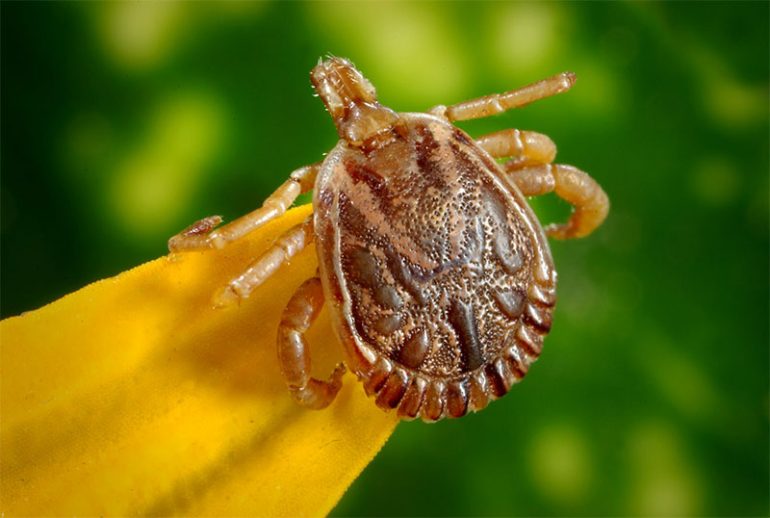
What Ticks Look Like
The biggest reason people remain unaware of the need to protect themselves is that ticks are mostly hidden.
Unlike mosquitoes, that we hear and see and know we need to protect ourselves against, ticks are stealthy. They can also be tiny.
Did you know that a tick can be as small as a poppy seed? Just look at this tweet from the CDC:
Ticks can be the size of a poppy seed. Can you spot all 5 ticks in this photo? Learn how to prevent tick bites. https://t.co/ATtrY7YFoS pic.twitter.com/gBm4tw2qmf
— CDC (@CDCgov) 4 May 2018
[Image description: The two photos in the above tweet show a distant and close-up shot of a poppy seed muffin. The ticks are indistinguishable from the poppy seeds unless you look very closely.]
Ticks can be difficult to spot but that doesn’t mean they aren’t present. Even when we can’t see them we need to think tick and take precautions like we would against mosquitoes.
Especially as we won’t always be aware when a tick bites us. This is because there are chemicals present in tick saliva that numb the skin.
Did you know that up to 50% of people infected with Lyme Disease do not recall a tick bite?
Avoiding Tick Bites To Prevent Lyme Disease
The most obvious way to prevent Lyme Disease is to avoid the possibility of a tick bite.
Ideally, this means staying away from tick habitats. Given what I said above, though, this isn’t always practically possible and I don’t believe people should fear going outdoors; there are many benefits to be had from being in nature.
However, we can and need to take precautions. The most obvious being to stick to well-defined paths and avoid brushing up against vegetation.
Dress Appropriately
It’s important to dress appropriately when out and about in tick territory.
I keep making the comparison to mosquitoes and it’s because we know to cover up when we are in an area where mosquitoes are prevalent.
We need to think similarly when it comes to ticks. One of the best ways to prevent a tick bite is to simply cover up.
Wear long trousers, long-sleeved tops and tuck your socks into your trousers if you are entering tick habitat.
Light-coloured clothing is a bonus because it makes ticks easier to spot.
You can even get anti-tick clothing that is pre-treated to repel ticks.
Use Tick Repellent
However, you can treat the clothes you already own by applying Permethrin. Do this several days beforehand.
DEET is considered the most effective tick repellent but it is also considered one of the most toxic.
Thankfully, there are natural tick repellents available too. Lyme Disease UK recommend a product called Mosi-Guard, which is available as a spray or stick (which is also great for travelling with hand luggage).
There are also essential oil tick repellents that you can make yourself. Personally, I use the following recipe:
- 1/2 cup of Witch Hazel
- 24 drops of Geranium essential oil
- 24 drops of Lavender essential oil
I originally learned about this recipe from a health coach called Ivonne who is @healthbeyondfood on Instagram. I simply doubled-up the recipe to fill my glass spray bottle.
I purchased these blue glass spray bottles from Amazon and they are perfect to use for my homemade tick repellent.
Check yourself To Prevent lyme Disease
One of the best precautions is to simply be vigilant and think tick.
Brush against vegetation? Stop and check yourself.
Been outside where you may have been exposed to ticks? Check yourself before you head back in your home.
Concerned there may be ticks on your clothing? Take it off and put it in the tumble dryer– the heat will kill the ticks.
Go for a shower after being in tick habitat and check yourself over. Be sure to ask someone to check areas you can’t see and don’t forget about checking your hair.
Carry Tick Removers
If you do happen to get bitten, the most important thing is to quickly and safely remove the tick.
Under no circumstances should you burn a tick with a match, cover it in petroleum jelly or apply anything else to dislodge it. This will only cause the tick to become stressed and regurgitate its stomach contents.
This increases your chance of infection.
Remove embedded ticks carefully using needle-pointed tweezers as close to the skin as possible and pulling directly out (being careful not to squeeze the tick; which is why you shouldn’t use eyebrow tweezers).
You can also purchase tick cards that can be used to remove ticks. These are favourable to use because they will not crush or squeeze the tick.
They are also great because they easily fit into wallets, purses and pockets. Carry them with you at all times so it’s to hand should you ever need it. .
The sooner you remove a tick the better.
It’s sometimes stated that removing a tick within 24-48 hours negates the risk of contracting Lyme Disease. This is actually false and not to be relied upon.
Transmission of the disease can occur sooner than 24 hours and the minimum attachment time for transmission of infection has never been established.
Don’t Forget your Pets
It’s not just us who can be bitten by ticks and contract Lyme Disease. We also need to protect our pets.
Not just for them, but for us! Cats and dogs can carry ticks into the home and potentially even transfer them onto us.
Speak to your vet about tick protection for your pet and be sure to check them over each time they have been outside too.
Consider Herbal Therapies
If you live in a Lyme endemic area, consider using herbal therapies. Stephen Buhner– a leading Lyme herbal expert– suggests taking the herb Atragalus as a preventative measure.
One of the best defenses against Lyme Disease is a healthy body and immune system.
Therefore, another option is the Daily Herbal Kit* from Vital Plan. Though not specifically created as tick prevention, this kit has been formulated to support cognitive health, balance energy and stress, and maintain joint and immune function.
In other words, it is a kit designed to help you stay as well as possible.
For those who feel they need additional support, there is also the Daily Immunity Kit*.
Disclaimer: always consult your doctor before taking a new supplement.
Be Aware of The Symptoms of Lyme Disease
In addition to awareness, education is one of the best tools for preventing Lyme Disease. I always recommend the book Unlocking Lyme by Dr Bill Rawls* and encourage everyone to read it.
Educate yourself about the early symptoms of Lyme Disease and what to look out for. Understand that removing a tick quickly is best but doesn’t necessarily negate the risk.
If you have any concerns speak to your doctor. Lyme Disease needs prompt medical intervention and treatment or serious complications can occur.
Early symptoms of Lyme Disease include:
- Feeling flu-like
- Low-grade fever
- Fatigue
- Chills
- Stiff neck
- Transient muscle aches
- Night sweats
- Stiff, painful or swollen joints
- Headaches
- Dizziness
- Rashes (though it’s important to note that not everyone gets the typical bull’s eye rash associated with Lyme Disease)
- Bell’s palsy
I hope you have found this post helpful in learning how to prevent Lyme Disease. If you have any information or tips to share, please add this in the comments below.
READ MORE:
- 8 things I’ve personally learned about taking antibiotics for chronic Lyme disease
- Do I Wish I Had Stem Cell Therapy for Lyme Disease Sooner?
- Herbs for Lyme Disease: How Do Herbal Therapies Help To Treat Lyme Disease?
Share on Pinterest: