February is Marfan Syndrome Awareness month and I’ll be completely honest with you. Until I started blogging and came across Shona Louise on Twitter, I had no idea what Marfan was. Perhaps, right now, you are even thinking, “what is Marfan Syndrome?”
Shona is a fellow chronic illness blogger who has Marfan Syndrome and I really admire her. She is a fantastic writer and disability advocate who shares a wealth of information on her blog. Today, as part of Marfan Syndrome Awareness month, Shona is kindly sharing her story to help raise awareness of this rare genetic condition.
Marfan Syndrome is a rare condition
Growing up with a rare condition can be a little tricky at times. Whether that be when you’re in the playground trying to explain to your friends why you can bend your thumb back. Or when you’re trying to explain to a teacher why you need to take the day off to go and get an ultrasound of your heart done. It really does involve a lot of explaining, because that’s the thing with a rare condition, no one has really heard of whatever you have!
Awareness is important
That’s why awareness days and months are so important; it gives people an opportunity to speak up and raise awareness and that’s why I’m guest posting on Donna’s blog today.
I have a genetic connective tissue disorder called Marfan Syndrome and this month is our awareness month! As well as it also being rare disease day on the 28th too. So, I just wanted to take the opportunity today to tell you a little about Marfan and my experience of living with it.
What is Marfan Syndrome?
Marfan Syndrome is a disorder of the body’s connective tissues; think of these tissues as being the glue that holds the body together. They are vital in maintaining the structure of the body and supporting internal organs and other tissues. It’s a genetic condition so most people inherit it from a parent but sometimes spontaneous mutation occurs, so your genes just mutate.
Everyone is affected differently by the condition
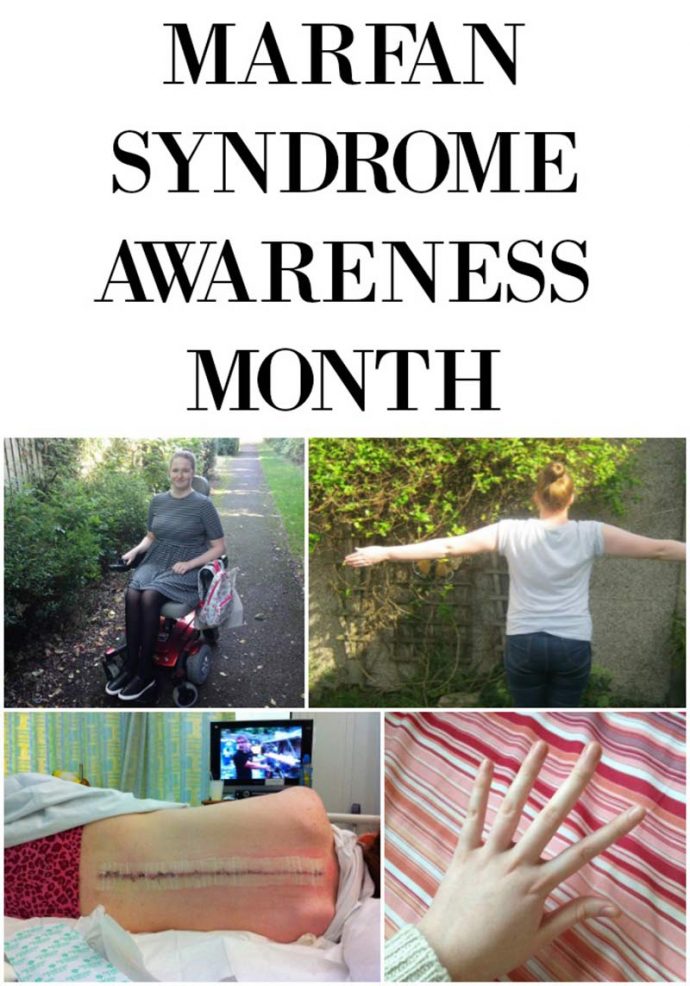
The severity of symptoms varies so much between individuals but there are certain signs to look out for that are associated with the syndrome. People with Marfan usually (but not always) have a tall and slim body, long arms, legs and fingers and loose (hypermobile) joints.
Other characteristics of the condition include small lower jaw, high roof of the mouth, flat feet, crowded teeth, skeletal deformities and heart problems.
Marfan Syndrome can affect the heart
The most serious side of Marfan, the side that makes this condition life threatening, is the aortic problems that can occur. The tissues in people with Marfan are too stretchy and this can allow the aorta, the main artery in the heart, to widen beyond what it should.
It can lead to the aorta tearing or even bursting, which can be a catastrophic and fatal event. This is why early diagnosis is so important. Too many people aren’t being diagnosed with Marfan Syndrome until it is too late.
Early diagnosis is important
Early diagnosis means that your heart can be monitored and if problems are found, they can be operated on. Marfan can also cause problems with the eyes, including dislocated lens; early glaucoma and cataracts; severe short-sightedness and retinal detachment.
Problems can also occur with the bones and nervous system: dislocated joints; curvature of the spine; deformities of the breastbone and dural ectasia.
Connective tissues are found all throughout the body so the list of problems that can occur because of Marfan is extensive and everyone has a different combination of such problems and symptoms.
There is also no cure for Marfan, problems are treated and managed instead.

Being diagnosed with Marfan Syndrome
I was diagnosed with Marfan when I was just a baby. My Mum knew she had the condition when she was pregnant with me, as sadly she had lost both her Dad and Brother to the condition.
When I was born my long arms, legs and fingers gave everyone an idea that I probably had the condition. An ultrasound of my heart confirmed the diagnosis as it showed that my aorta was larger than it should be for my age.
Growing up with Marfan Syndrome
Growing up, I only really suffered from mild joint pains and most of my joints were hypermobile. But when I was a young teen I got my first secondary diagnosis, Scoliosis. This is an abnormal curvature of the spine.
Scoliosis led to me having surgery
At first, my curve was only mild but a growth spurt increased the curve and my pain increased with it. So, in 2013, I had spinal fusion surgery to correct the curve. This is a long and major surgery where they manipulate your spine into a straighter position using metal rods and screws.
I wrote a diary style post about my week in hospital when I had the surgery to share what it was like. The surgery didn’t go to plan, though, as just a few days later I was experiencing severe pain down my right leg.
Problems resulting from surgery
At first, it was put down to being a symptom of Marfan, but a CT scan 6 months later revealed that a screw was sitting on a nerve. So, nearly a year after the first surgery I was wheeled into theatre again to have the screw removed and replaced.
I thought after that it was all over but just a few months after the second surgery I started getting pains in my hips so off I went to the doctors! I was referred to a hip surgeon and X-Rays showed that I had another Marfan-related condition, Protusio Acetabuli.
What is Protusio Acetabuli?
Protusio Acetabuli is an uncommon hip deformity. The hip sockets are too deep and this left me with early wear and tear, cyst formation and with only about 3mm of bone left in my hip socket. This meant that at the age of 18 I had to have my right hip, which was worst affected, fully replaced; the kind of surgery that is mostly done on the older generation!
I was one of the youngest people that my surgeon had done a hip replacement on and I still need my other hip replacing at some point too.
The problems associated with Marfan feel never-ending
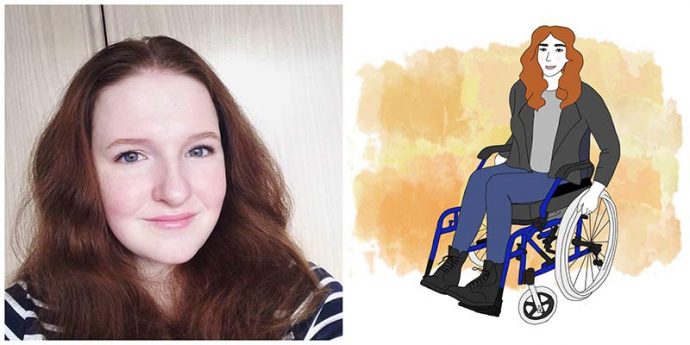
During this time, I also had ever increasing pains in my lower back that were being investigated. It really can be never ending with this kind of condition! The pains were so severe that I had to start using a powerchair to get around. However, the catch-22 was that my pain got worse when I was sitting up, so I couldn’t even use my powerchair for too long.
Through these investigations, another diagnosis was revealed
MRI and CT scans finally revealed that I was about to receive my 3rd major secondary diagnosis. I had a 5.5cm wide Tarlov Cyst in my sacrum (the triangle bone between your lumbar spine and your tailbone) and also dural ectasia, though I knew about the latter already.
What is a Tarlov Cyst?
A Tarlov Cyst is a dilation of a nerve root which then fills with spinal fluid. This explained the pain and also the regular headaches and migraines that I had been experiencing.
We also found that the cyst had already eroded away a significant amount of my sacral bone and this has left me at risk of fracturing my sacrum. Surgeons have decided, though, that operating to remove the cyst is too risky. So my options right now are just pain management and I’d be lying if I said I wasn’t scared about the future.
Further problems arose
Around that time I also had my regular cardiology appointment where I have an ultrasound of my heart to monitor my aorta. After years of relatively good news, I found out that my aorta had started enlarging more, to the point where words like ‘surgery’ were being thrown around.
My surgeons predict that I’ll need major open heart surgery to replace a portion of my aorta in my early twenties, I’m 19 now. I’ve always known that I’ll need heart surgery but I thought it would be in my 30’s or 40’s so it did take a while to get my head around that!
Putting my energy into something positive
Focusing my energy on blogging and raising awareness of Marfan helps me to not worry, though. I’m trying to turn my bad experiences into a good thing! Hopefully, you’ve learnt a thing or two about Marfan Syndrome today.
If you want even more information then you can head over to the NHS choices website or there is also an information page on Marfan Syndrome on my blog.
|
|
 About the author: